
Choosing Your First Tandem Skydive in New Zealand: Expert Tips for an Unforgettable Adventure!
Are you thinking about doing your first tandem skydive in New Zealand? This guide will help you choose the right tandem skydive and arrive on the day feeling confident, prepared, and excited for your skydiving experience.
With three jump heights, different freefall times, and a fair few decisions to make before you book, it’s completely normal to have questions. What does freefall actually feel like? Is tandem skydiving actually safe? Which altitude should you choose? And what can you expect on the day?
We talk first-time jumpers through exactly these questions every day at our Skydive Auckland dropzone. We’re trusted for providing the most thrilling, safe, and exciting experience possible, and that starts with you feeling prepared and confident.
What Is a Tandem Skydive?
A tandem skydive is the perfect way to do your first jump, because you don’t need any experience, training, or licence to do it. You’ll be harnessed to an experienced tandem instructor throughout the experience, who manages the technical side of the jump while you get to enjoy the adrenaline, the scenery, the freefall, and take in the whole thing.
Prior to your skydive, you’ll get a short ground briefing covering two things: how to hold your body in freefall, and how to lift your legs for landing. These simple positions help make your jump easy and safe, while your tandem master takes care of everything else. It’s also your chance to ask our experienced crew any questions or raise any concerns.
You’ll board our modern 17-seat turbine aircraft for a 20 to 25 minute scenic flight up to your chosen altitude, freefall for between 45 and 75 seconds depending on the height you pick, then enjoy a scenic 5-minute parachute ride back down to the ground.
What Does Freefall Feel Like?
The feeling of freefall surprises most people, and it certainly doesn’t feel how they expect. After only a few seconds of acceleration, the air resistance supports your body completely, removing that stomach-drop sensation you get on a roller coaster and making it feel more like flying or floating than falling. Freefall is loud and windy, similar to sticking your head out of a car window on the motorway, and you’ll be able to breathe normally the whole way through.
Your body knows exactly what to do, and you’re paired with an expert who’s done this thousands of times, backed by everything you covered in your safety briefing. Our advice is simple: relax, smile, let out a scream if you feel like it, and take in the incredible views of Auckland and New Zealand below you.
Is It Normal to Feel Nervous Before Your First Skydive?
Yes, nerves are completely normal before your first skydive.
Nearly every first-time jumper feels some nerves beforehand, usually driven by a few things: a fear of heights, a fear of falling, and a fear of the unknown. Understanding what actually happens during a skydive is the best way to replace uncertainty with confidence.
Skydiving in New Zealand is regulated by the Civil Aviation Authority (CAA), and every jump pairs you with an instructor affiliated with the NZPIA (New Zealand Parachute Industry Association). Feeling nervous or scared is completely natural and instinctive, but we believe facing that fear and taking the leap is one of the most empowering experiences you can have, a memory that will stay with you for the rest of your life.
How Do You Choose Your Altitude?
The higher you jump, the longer your freefall. It’s also why our 18,000ft skydive is our most popular option, since it’s the highest tandem skydive available in New Zealand.
When deciding which altitude is right for you, consider how much freefall time you want, your comfort level with altitude, the duration of your scenic flight, and how it fits your budget.
At 13,000ft, you’re looking at around 45 seconds of freefall and great views over Auckland’s west coast, perfect for budget travellers or anyone who just wants a taste of freefall. Step it up to 16,000ft and you’ll get around 60 seconds of freefall. Go all the way to 18,000ft and that’s New Zealand’s highest tandem skydive, up to 75 seconds of freefall, with views over both coastlines, Waiheke Island, Great Barrier Island, and Mt Ruapehu on a clear day.
If you’re still not sure which one, here’s a fairly reliable rule: nobody ever lands wishing they’d jumped from lower! If you’re unsure which altitude suits you or have any questions, our friendly team can offer recommendations and advice.
How Safe Is Tandem Skydiving?
Safety comes before everything else at Skydive Auckland. Every one of our tandem instructors is a highly trained professional who has completed a rigorous certification process, and skydiving in New Zealand operates under close oversight from the Civil Aviation Authority (CAA) and the NZPIA, giving you multiple layers of regulation behind every jump.
Each tandem rig carries both a main and a reserve parachute, along with an Automatic Activation Device (AAD) that deploys the reserve automatically if it senses you’re still in freefall past a safe altitude. All our equipment is checked daily and packed by licensed riggers, so nothing goes up in the air without being properly inspected first.
Between the built-in backup systems, the regulatory oversight, and instructors who’ve done this thousands of times, tandem skydiving is one of the more heavily safeguarded ways to get an adrenaline rush.
What Are the Requirements for Your First Tandem Skydive?
Before you book, it’s worth checking that you meet our basic requirements.
Weight and Size
Skydive Auckland operates a 100kg weight restriction for tandem skydiving. In some cases, tandem skydiving can still be suitable for people who weigh more than 100kg. If that’s you, you’ll need to go through a pre-assessment on the day of your jump to confirm it’s possible. There’s also a 30kg minimum weight restriction, and we’re unable to take small children in stronger wind conditions.
Age
There’s no upper age limit (we’ve taken jumpers as young as 5 and as old as 97). So long as you meet our weight and size requirements, age alone won’t stop you from jumping. Anyone under 18 will need a parent or guardian to sign their waiver, and the 18,000ft jump is limited to those 12 and over.
Health Considerations
If you’re unsure whether an existing medical condition or injury will affect your skydive, please consult your doctor for advice, as we’re unable to advise on medical issues ourselves. We’re proud holders of the Trax Seal of Approval for accessible adventure, and we do our best to tailor the experience to suit any jumper’s needs, having taken people with a range of conditions, including paraplegics, skydiving with us before. Get in touch with our team if you have any accessibility questions and we’ll talk you through what’s possible.
Preparing for Your Skydive
You can eat before you skydive, and we recommend that you do. Skydiving shouldn’t make you feel sick, so a regular meal 1 to 2 hours prior to your skydive is perfectly fine. Drink water, skip the alcohol for at least eight hours before, and get a proper night’s sleep. A well-rested brain handles nerves way better than a sleepy one.
A lot of people ask us what they should wear. We recommend comfortable, weather-appropriate activewear like flexible pants or leggings and a t-shirt. Fully enclosed, secure flat shoes such as lace-up trainers or sneakers are mandatory. Avoid bulky clothes, skirts, high heels, or loose jandals. A jumpsuit will be provided to wear over your outfit. Wear glasses? No worries, goggles fit right over them.
Your Day at Skydive Auckland
Plan to allow around 3 hours for the full experience, or about 5.5 hours if you’re using our free transport from the city.
Getting to Parakai
Skydive Auckland is based in Parakai, about 45 minutes northwest of Auckland’s city centre. If you’d rather not drive, we offer free return transport from Auckland City on direct bookings, just let us know when you book if you’d like to use it, as it’s subject to availability. Travelling this way means you can sit back and enjoy the ride instead of navigating on the big day. If you’re driving yourself, we’ve got plenty of free onsite parking waiting for you.
Check-In and Paperwork
You’ll check in on one of our iPads on arrival, where our team walks you through the package options available so you can choose what suits you. This involves the usual routine paperwork, including a standard legal waiver that’s normal for any adventure sport. If you want to speed things up, you can complete your waiver online ahead of time using the link we send you when you book.
You’ll then watch a short safety video, covering the activity itself along with the two body positions you’ll need on the day.
The arch position. Your main job during freefall is holding a simple body position, a gentle banana shape, made by pushing your hips forward. It creates stability in the air, and most people find it comes naturally the moment they’re actually out there.
The landing position. Your only other task comes right at the end. Lift your legs straight out and up, and your instructor’s feet touch down first for a smooth, often sliding finish.
After the video, you’ll get fitted with your jumpsuit, harness, goggles, and hat.
Weather Pauses
Skydiving is entirely weather dependent, so don’t be surprised if there’s a short delay for wind or cloud while you’re onsite. It’s completely normal, and a sign our team is putting your safety first rather than rushing a jump that isn’t ready. We’ve got free BBQ facilities, onsite parking, and a viewing deck if you want to make a relaxed day of it while you wait.
Meeting Your Tandem Instructor
Finally, you’ll meet the most important person of your day: your tandem instructor. They’re a highly qualified professional, often with thousands of jumps behind them, and they’re your guide for the rest of the experience, responsible for everything from gear checks to deploying the parachute and getting you safely back on the ground. Time to relax and take it all in.
How Can I Get Photos and Videos of My Skydive?
Personal cameras, phones, and GoPros aren’t permitted on the jump. Per New Zealand Civil Aviation Authority (CAA) regulations and standard safety policy, passengers can’t carry their own recording devices, since loose items become genuinely dangerous at 200km/h in freefall. Instead, we offer a few professional media packages depending on what you’re after.
Handy Cam Video: video footage captured by your tandem instructor’s own handy cam.
Handy Cam Video & Photos: the best of both worlds. You’ll get video to relive the whole jump, plus still photos that are perfect for sharing straight away, all captured from your instructor’s handy cam.
Ultimate: Handy Cam + Outside Cam: this is the one we’d recommend if you want the full cinematic experience. Alongside your instructor’s handy cam, a second camera flyer jumps separately and films you from the outside, capturing those classic wide shots of you in freefall against the sky and the Auckland landscape below. It’s the only package that gets you an external angle, showing your whole body in the air rather than just a close-up from your instructor’s camera.
However you book it, your photos and videos are emailed to you after your skydive, so you can easily view, download, and share them.
What Makes Auckland the Best Place to Skydive?
Skydive Auckland is home to the highest tandem skydive in New Zealand at 18,000ft, along with views most operators simply can’t offer: both of Auckland’s coastlines, Waiheke Island, Great Barrier Island, and Mt Ruapehu on a clear day, all in one jump.
We’re based in Parakai, just 45 minutes from Auckland’s city centre, with free return transport available on direct bookings, so you don’t need to plan a full day trip to fit it in. Our team has over 20 years in the industry, we’re affiliated with the NZPIA, and we hold Qualmark Gold accreditation, recognising us as one of the highest quality, safest adventure experiences in the country. We’re also ranked the number one tour in Auckland on TripAdvisor, out of over 200 tours and activities, with a Certificate of Excellence to back it up.
You’ll fly in our modern 17-seat turbine aircraft, watch your friends and family cheer you on from our viewing deck, and make a day of it with free onsite parking and BBQ facilities. For a first tandem skydive in New Zealand, it’s hard to beat.
What Happens After Your Parachute Opens?
Once your parachute deploys, the noise drops away almost instantly, and freefall shifts into a peaceful five-minute ride back down to Parakai. Many jumpers say this is actually their favourite part of the whole experience: it’s quiet, the adrenaline settles, and you finally get a proper look at the views you just fell through.
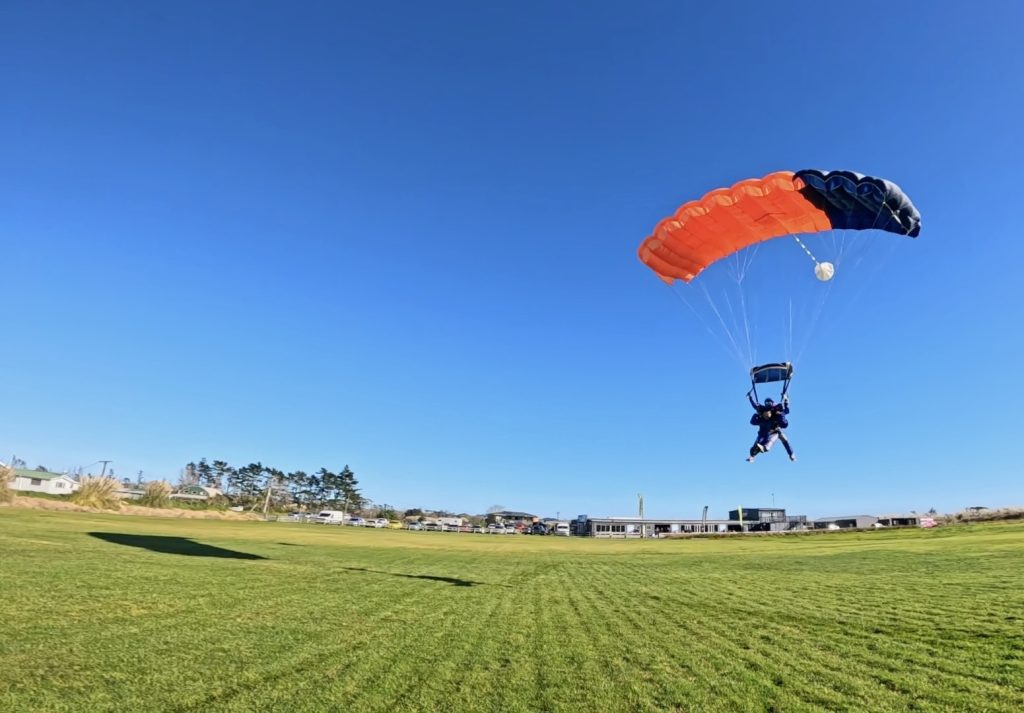
Your tandem instructor flies you back toward the dropzone and may let you help steer the canopy if you’d like to. As you come in to land, it’s the same position from your briefing: legs out and up, letting your instructor’s feet touch down first for a smooth finish. Your friends and family can watch you land from our viewing deck, right before you’re back on solid ground buzzing from the whole thing.
Frequently Asked Questions
Do I need any experience to do a tandem skydive? No. Tandem skydiving is designed for first-timers, your instructor handles the technical side of the jump.
Which altitude should I choose for my first jump? All three work well. 13,000ft is the most accessible way to get the full experience, 16,000ft adds more freefall time, and 18,000ft is New Zealand’s highest tandem skydive with the longest freefall and best views.
Will I get that stomach-drop feeling, like on a roller coaster? No. Because you leave the plane already moving forward, there’s no straight drop. Within seconds you’re supported by a cushion of air, which feels more like flying than falling.
Is tandem skydiving actually safe? Skydiving in New Zealand is regulated by the Civil Aviation Authority (CAA), and every jump pairs you with an instructor affiliated with the NZPIA. Every tandem rig carries a main and reserve parachute plus an automatic backup device.
Can I bring my own camera or phone? No, phones, cameras, and GoPros aren’t allowed on the jump for safety reasons. You can book a professional video or photo package instead.
What should I wear? Comfortable, weather-appropriate activewear and secure, laced, closed-toe shoes. Avoid skirts, high heels, jandals, or bulky clothing.
Is there a weight or age limit? Yes, our weight range is 30kg to 100kg. There’s no upper age limit, though under-18s need a parent or guardian to sign their waiver, and the 18,000ft jump requires jumpers to be 12 or older.
Can my family or friends watch? Yes, our viewing deck at Parakai is set up exactly for that.
How long does the whole experience take? About 3 hours door to door, or around 5.5 hours if you’re using our free transport from Auckland City.
What happens if the weather isn’t suitable? Skydiving is entirely weather dependent. If conditions aren’t right, we’ll refund you or help you reschedule at no extra cost.
Ready to Book?
Once you’ve picked your altitude, decided on a media package, and chosen a date with a bit of flexibility built in, the rest is really up to us. Book your tandem skydive with Skydive Auckland and see New Zealand’s highest jump for yourself.